In the whirlwind of modern life, the desire for a deep, meaningful connection has never been stronger. Yet, despite this universal craving, we’re often left navigating the complexities of relationships with no clear map. We see picture-perfect couples on social media and wonder what we’re missing, but we’re rarely given a guide on how to actually build that kind of partnership. The good news? A great relationship isn’t something you find; it’s something you build.
This is not just another list of high-level tips. This is your practical, step-by-step playbook, designed for action. We’re moving beyond theory to give you the specific tools and exercises you need to create a resilient and loving partnership.
Throughout this guide, you will master the key pillars of a healthy relationship: developing practical communication skills that foster understanding, implementing a framework for building unbreakable trust, learning to balance your independence with partnership, and adopting a growth mindset to turn challenges into connection. While some guides explore whether you are ready for a relationship, this playbook focuses on the essential skills needed to actively build and sustain one for the long haul.
Mastering communication: your foundational skill for connection
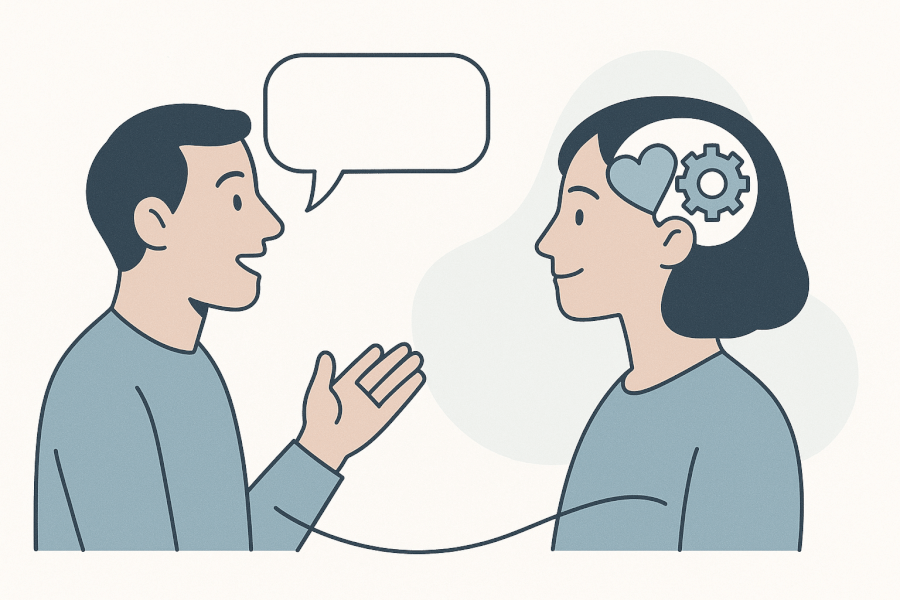
Effective communication is the lifeblood of a healthy relationship. It’s the bridge that connects two individual worlds, allowing for intimacy, understanding, and mutual support. But what does “good communication” actually look like in practice?
Why ‘just talk more’ isn’t enough: moving from theory to practice
Many of us fall into the trap of believing that the more we talk, the better we’re communicating. We spend hours in conversation but still feel misunderstood, leading to frustration and conflict. This is the critical difference between the frequency of communication and the quality of it. The solution is to shift from aimless talking to intentional communication—a structured, mindful, and skill-based approach to interaction where the goal is true understanding, not just exchanging words.
The active listening exercise: a step-by-step guide
This exercise is designed to train you and your partner to listen for understanding, not just to respond. It is one of the most powerful tools for preventing misunderstandings.
- Set a timer for three minutes. Decide who will be the speaker and who will be the listener first.
- The speaker talks. For the next three minutes, the speaker shares what’s on their mind. It could be about their day, a feeling they’re having, or a recent stressor. The key is to speak without interruption.
- The listener listens. The listener’s only job is to be present and absorb what is being said. Do not interrupt, plan a rebuttal, or offer solutions. Just listen.
- Summarize and validate. When the timer goes off, the listener’s job is to summarize what they heard. They can start with, “What I heard you say was…” After summarizing, they must ask, \”Did I get that right?\”
- Switch roles. The speaker confirms or gently corrects the summary until they feel fully heard. Then, you switch roles and repeat the exercise.
The weekly check-in template: a script for proactive connection
Instead of waiting for problems to fester, proactive relationship maintenance keeps your connection strong. Schedule a calm, dedicated time once a week to ask each other these simple, non-confrontational questions:
- “What’s one thing I did this week that made you feel appreciated?”
- “Is there anything you need more of from me next week?”
- “What’s taking up most of your headspace right now?”
- “How are we doing on a scale of 1-10, and what could we do to get closer to a 10?”
‘I’ statements revisited: framing needs without blame
You’ve probably heard of “I” statements, but their power lies in their execution. They are not about starting a sentence with “I think you…” but about expressing your feelings and needs without attacking your partner.
- Before: \”You never help around the house.\” (This is a blame statement that invites defensiveness.)
- After: \”I feel overwhelmed by the chores, and I would feel really supported if you could help with the dishes tonight.\” (This expresses a feeling, identifies a need, and offers a specific, actionable solution.)
Building unbreakable trust: the playbook for consistency and vulnerability
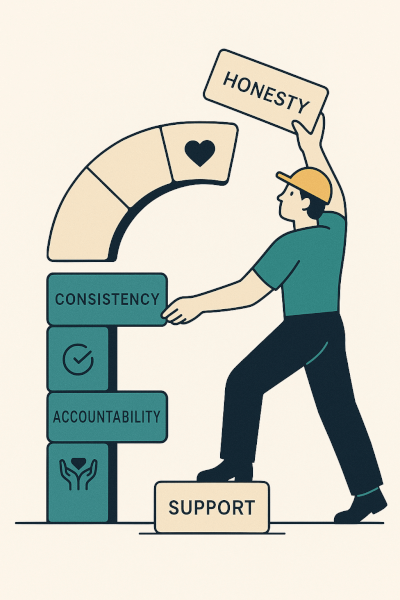
Trust is the foundation upon which all healthy relationships are built. Without it, there is no emotional safety, and without safety, there can be no true intimacy.
What is trust, really? moving beyond the dictionary definition
In a relationship, trust isn’t blind faith. It’s a confident belief in your partner’s reliability, integrity, and care for your well-being. It’s the deep-seated knowledge that they have your back. Trust can be broken down into three actionable components:
- Consistency: Do their actions match their words over time?
- Accountability: Do they take responsibility and make amends when they make a mistake?
- Emotional Safety: Do you feel safe being vulnerable with them without fear of judgment or ridicule?
The consistency framework: small actions build the strongest bonds
Trust isn’t built in grand, heroic gestures. It’s forged in thousands of small, everyday moments. Renowned relationship experts at The Gottman Institute call these “sliding door moments”—the small opportunities to turn towards your partner. According to a guide to building trust from Utah State University, this consistency is a cornerstone of a lasting connection.
Focus on these small, consistent actions to build a powerful foundation of trust:
- Say what you mean and mean what you say.
- Follow through on promises, no matter how minor.
- Be on time and communicate if you are running late.
- Listen without checking your phone.
- Remember small details they’ve shared with you.
- Celebrate their wins and support them through their challenges.
Accountable apologies: how to repair trust after a minor conflict
Everyone makes mistakes. The strength of your relationship is determined not by the absence of conflict, but by your ability to repair it. A real apology rebuilds trust; a non-apology erodes it.
Avoid saying, \”I’m sorry you feel that way.\” Instead, use this simple, 3-step formula for a genuine, accountable apology:
- Acknowledge the specific action: \”I’m sorry that I was dismissive of your feelings last night when you were trying to talk to me.\”
- Express remorse for the impact: \”I know that made you feel unimportant and unheard, and that was not okay.\”
- State what you will do differently: \”Next time you need to talk, I will put my phone away and give you my full attention.\”
The modern dating playbook: navigating technology and ambiguity
Dating in the 21st century comes with a unique set of challenges. Technology has changed the landscape, and many people struggle with uncertainty and a lack of clear communication.
From dating apps to defined relationships: communicating intentions clearly
One of the biggest pain points in modern dating is the ambiguity that flourishes on dating apps and in the early stages of getting to know someone. The most effective way to cut through this confusion is with clear, kind, and direct communication.
If you are looking for a serious partnership, it’s okay to state that. After a few dates, once you know you’re interested in pursuing something more, you can use a script like this:
\”I’m really enjoying getting to know you and I just want to be open and say that I’m at a place where I’m looking for a serious partnership. I wanted to share that to make sure we’re on the same page about what we’re looking for.\”
This isn’t an ultimatum; it’s an invitation to clarity. It respects both your time and theirs.
Digital wellness for your relationship: setting boundaries with technology

Our phones can be a major source of disconnection if we don’t manage them intentionally. The constant pings and notifications can make a partner feel secondary. Discuss and establish simple, practical boundaries to protect your connection.
- Phone-Free Dinners: Commit to putting your phones away during meals.
- Bedtime Boundaries: Leave your phones on the nightstand and don’t scroll in bed. Use that time to talk and connect instead.
- Social Media Privacy: Have an open conversation about what you are both comfortable sharing online regarding your relationship.
How to handle ghosting and uncertainty with resilience
Ghosting is a painful and unfortunately common experience. If it happens to you, it’s crucial to frame it correctly. Ghosting is a reflection of the other person’s communication skills, not your worth. Someone who is unable to communicate an ending, even a simple one, is not someone who has the skills required for a healthy, mature relationship. View it as a filter that effectively removes people who are not ready or able to build the kind of connection you deserve.
The ‘we’ and the ‘me’: balancing individuality with a strong partnership

A truly great partnership is made of two whole individuals who choose to share their lives, not two half-individuals trying to become one.
Why losing yourself in a relationship is a risk to its health
It can be tempting to merge completely with your partner, especially in the beginning. However, losing your sense of self—your hobbies, your friendships, your personal goals—is a danger to the long-term health of the relationship. Maintaining your individuality makes you a more interesting and engaged partner. It brings new energy into the relationship and prevents the dynamic from becoming stale or codependent. Independence is a strength, not a threat.
Practical strategies for maintaining personal hobbies and friendships
- Schedule solo time: Actively block out time on your calendar for yourself. This could be one night a week for a class, time with your own friends, or simply an afternoon to read a book alone.
- Share your experiences: After you’ve had your solo time, share what you did or what you learned with your partner. This builds connection and shows that you are interested and invested in each other’s individual lives and growth.
Codependency vs. healthy interdependence: a simple checklist
Understanding the difference is key to ensuring you are building a healthy dynamic.
| Codependency (Unhealthy) | Healthy Interdependence |
|---|---|
| Your self-worth is tied to your partner’s approval. | You maintain a strong, independent sense of self-worth. |
| You consistently sacrifice your own needs and desires. | You balance your needs with the needs of your partner. |
| You feel responsible for your partner’s emotions. | You are supportive but recognize they own their feelings. |
| Your identities have merged; there is no “me” left. | You are a “we,” but you are also still a distinct “me.” |
| You avoid conflict at all costs to keep the peace. | You see conflict as an opportunity to understand and grow. |
Adopting a growth mindset: turning challenges into connection

The narrative of the “perfect” relationship is a myth. Every single relationship has challenges. The difference between couples who thrive and couples who fail is their mindset.
The myth of the ‘perfect’ relationship: embracing imperfection
Social media often presents a highlight reel of perfection, creating an unrealistic standard that can make us feel like our own relationship is failing when we face normal challenges. A growth mindset in a relationship is the core belief that your abilities, your communication skills, and your connection are not fixed. They can be developed and improved over time. Challenges are not a sign of incompatibility; they are opportunities to grow closer.
How to view conflict as a catalyst for growth, not a sign of failure
According to the Gottman Institute’s research on relationship wellness, all couples have conflict. The key is not to avoid it, but to learn how to repair it effectively. Conflict simply shines a light on the areas of your relationship that need attention. When you see a disagreement as a chance to practice your communication skills, deepen your understanding of your partner, and strengthen your bond, you transform it from a threat into a powerful tool for connection.
Applying the five love languages: a daily action plan
Going beyond just knowing your partner’s love language, the key is to put it into daily, practical action. Here is one simple, daily example for each:
- Words of Affirmation: Send a text in the middle of the day saying, \”I’m thinking of you and I’m so proud of you.\”
- Acts of Service: Make them a cup of coffee in the morning without being asked, or take care of a chore you know they dislike.
- Receiving Gifts: Leave a small chocolate bar or their favorite snack on their desk with a little note.
- Quality Time: Set aside 20 minutes of phone-free, uninterrupted time to just talk about your day.
- Physical Touch: Give them a meaningful, six-second hug when you leave in the morning or greet them at night.
Your actionable relationship 101 checklist
- Master Communication: Practice the Active Listening Exercise once this week.
- Build Trust: Pick one small, consistent action to focus on daily (e.g., following through on a promise).
- Navigate Modern Dating: Have one clear conversation about expectations, either with a new partner or a current one.
- Balance ‘We’ and ‘Me’: Schedule one hour of dedicated solo time this week to pursue a personal hobby.
- Adopt a Growth Mindset: Identify one recent challenge and discuss what you learned from it as a couple.
A strong, healthy relationship is not a lottery ticket you find; it’s a house you build, brick by brick. The skills required—communication, trust, empathy—are not innate traits. They are learnable, practical abilities. You are now equipped with a playbook of exercises, scripts, and frameworks, not just abstract ideas.
Your journey to a stronger, more connected partnership starts with the very first step. You don’t have to do everything at once. Begin with one exercise from this guide this week and build from there. You have the power to create the relationship you desire.
Frequently asked questions about building a relationship
What are the foundations of a healthy relationship?
The foundations of a healthy relationship are mutual respect, trust, open communication, and shared values. These core elements allow a partnership to navigate challenges and grow stronger over time, with each partner feeling safe, valued, and understood.
How can couples improve communication?
Couples can improve communication by practicing active listening, using ‘I’ statements to express needs without blame, and scheduling regular, calm check-ins. Moving beyond blame and focusing on understanding the other’s perspective is the most critical shift for effective dialogue.
How is trust built in a relationship?
Trust is built through consistent, reliable actions over time. This includes keeping promises, being honest, apologizing accountably after mistakes, and showing through everyday behavior that you are a safe and dependable partner. As noted in research from sources like Utah State University, it is this consistency in small moments that forges a lasting connection.
Why is individuality important in a partnership?
Individuality is important because it prevents codependency and keeps the relationship dynamic and healthy. When both partners maintain their own hobbies, friendships, and sense of self, they bring more energy and interest to the partnership and avoid losing their personal identity in the other person.
What is proactive relationship maintenance?
Proactive relationship maintenance is the practice of actively strengthening your connection before problems arise, rather than only addressing issues reactively. It involves regular check-ins, scheduled quality time, and continuously practicing communication skills to keep the foundation of the relationship strong and resilient.