
You’re sitting on the couch after a long day. Your partner is next to you. You both know you should connect, so someone asks the inevitable question: “how was your day?” The answer is a familiar script of logistics, deadlines, and what to have for dinner. The conversation ends, and you both retreat to the silent glow of your phones, a tangible distance growing in the space between you.
If this scene feels painfully familiar, you’re not alone. Many couples in long-term relationships find themselves stuck in a cycle of surface-level communication, feeling more like roommates than romantic partners. The deep, exciting conversations you once had seem like a distant memory, and you’re craving a way to find that connection again.
This is not just another list of questions. This is a complete guide to transforming your communication. We’ll give you the ‘what’—over 150 expertly curated questions for every stage and challenge of your relationship—but more importantly, we’ll give you the ‘how.’ You’ll learn a simple framework for having conversations that build intimacy instead of feeling like an interrogation. It’s time to move beyond ‘how was your day?’ and start exploring the adventure of your relationship, one intentional question at a time.
The foundation: why intentional questions transform relationships

To truly understand the power of asking better questions, we need to look at the psychology of what makes a relationship thrive. It’s about more than just talking more; it’s about creating a specific kind of interaction that fosters intimacy.
At the heart of this is a principle called “reciprocal self-disclosure.” In simple terms, when you share something vulnerable and personal, it signals trust and invites your partner to do the same. This back-and-forth exchange of inner worlds is the engine of emotional closeness. Intentional, open-ended questions are the keys that turn that engine on.
World-renowned relationship researchers Drs. John and Julie Gottman built their entire framework for healthy relationships on a related idea. They call it “The Gottman Institute’s Love Maps concept.” Think of a Love Map as a detailed GPS of your partner’s heart and mind. It’s your intimate knowledge of their history, their worries, their proudest moments, their quirky dreams, and their deepest fears.
A strong relationship is built on a detailed, constantly updated Love Map. But people change—their goals shift, new anxieties emerge, and they discover new passions. Asking intentional questions is the most effective tool you have to update that map, ensuring you never get lost in your partner’s world. It’s the foundation of a resilient, deeply connected partnership.
The art of the conversation: your framework for connection
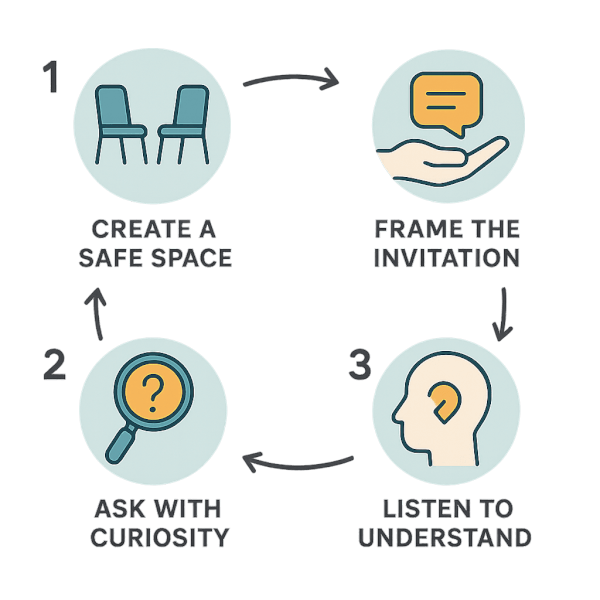
Perhaps the biggest fear holding people back from asking deeper questions is the worry that it will feel awkward, forced, or like a therapy session. “Where do I even start? What if they don’t want to talk?” The solution is to create a simple, repeatable framework that makes these conversations feel natural, safe, and even fun.
Here is a four-step framework to turn a simple question into a powerful moment of connection.
Step 1: create a safe space
The right environment is everything. A deep conversation will fall flat if the TV is blaring or you’re both trying to answer emails. Creating a safe space means consciously setting the stage for connection.
- Timing is key: Don’t initiate a deep conversation when your partner is stressed, exhausted, or walking in the door from a terrible day at work. Choose a relaxed moment, like over a cup of coffee on a weekend morning, on a walk, or after dinner when the chores are done.
- Eliminate distractions: Make a mutual agreement to put your phones away. Turn off the TV. Give each other the gift of your undivided attention.
Step 2: frame the invitation
How you begin the conversation sets the entire tone. Instead of ambushing your partner with a deep question out of the blue, frame it as a positive and collaborative invitation.
Try one of these gentle openers:
- “I was thinking about us and I’d love to connect on a deeper level. Could we set aside some time to ask each other some fun questions?”
- “I really miss feeling connected to you. I found some interesting conversation starters I’d love to try together sometime this week.”
- “I feel like we talk a lot about logistics. I’d love to carve out 15 minutes tonight to just talk about us.”
Step 3: ask with curiosity, not accusation
Your tone matters more than the words themselves. The goal is to explore your partner’s world with genuine curiosity, not to lead them to a specific answer or prove a point. Avoid questions that have a hidden judgment.
- Instead of: “Why don’t you ever plan date nights for us?”
- Try: “What would a perfect date night look like to you if we could do anything?”
The first is an accusation; the second is an invitation to dream together.
Step 4: listen to understand, not to respond
This is the most critical skill in any conversation. Most of us listen while simultaneously planning what we’re going to say next. Active listening means quieting your own mind and focusing completely on your partner’s words and feelings.
- Don’t interrupt: Let them finish their thought completely.
- Ask clarifying questions: “What I hear you saying is… is that right?”
- Validate their feelings: You don’t have to agree with them to show you understand. Simple phrases like, “That makes sense,” or “I can see why you would feel that way,” can make your partner feel seen and heard.
A curated library of questions for your relationship adventure
Think of this section as your toolbox. You don’t need to use every tool at once. Pick a category that feels most relevant to your relationship right now and choose one or two questions to start with.
Questions to deepen emotional intimacy and connection
These questions are designed to explore your inner worlds, values, and feelings.
- When do you feel most loved and appreciated by me?
- What’s something you feel proud of this week, big or small?
- What’s a dream you’ve never told me about?
- Is there a part of your past that you feel has shaped you the most?
- What does “home” mean to you?
- What is one thing I could do that would make you feel more seen?
- What’s a fear you have about your future?
- In what ways have we grown together?
- What is one of your favorite memories of us?
- What quality in me do you admire the most?
The 36 questions that lead to love
In 1997, psychologist Arthur Aron and his colleagues conducted a study to see if they could experimentally create closeness between strangers. The result was a specific set of 36 questions designed to escalate in vulnerability, fostering the “reciprocal self-disclosure” we talked about earlier. While you’re not strangers, these questions can be a powerful way to rediscover each other.
You can find the full list in this article on the “36 Questions for Increasing Closeness” from the Greater Good Science Center, but here are a few examples to give you a taste:
- Given the choice of anyone in the world, whom would you want as a dinner guest?
- What would constitute a “perfect” day for you?
- For what in your life do you feel most grateful?
- If you could wake up tomorrow having gained any one quality or ability, what would it be?
- What is your most treasured memory?
- Share with your partner an embarrassing moment in your life.
- When did you last cry in front of another person? By yourself?
This method was detailed in the original 1997 study on interpersonal closeness and has become a famous tool for building connection.
Questions about your future together
These questions help you align on your shared goals and ensure you’re building a life you both want.
- What does your ideal life look like in 5 years?
- What’s one thing you want us to achieve together next year?
- How do we want to handle finances as a team?
- What does adventure mean to you, and how can we have more of it?
- What is a boundary you want to set for our life together (e.g., around work, family, etc.)?
- What tradition do you want to create for us?
- How do you envision us supporting each other’s personal goals?
- What does retirement look like to you?
- What is a fear you have about our future together?
- What are you most excited about for our future?
Fun and playful questions to reignite the spark
Remember, your partner is also your friend. These lighthearted questions can bring back a sense of playfulness.
- If we could go on an adventure anywhere right now, where would we go?
- What’s a silly memory of us that always makes you smile?
- What’s a new hobby you’d like to try together?
- If we were a famous duo, who would we be?
- What’s a song that makes you think of me?
- What’s the best or worst meal we’ve ever shared?
- If you could have any superpower, what would it be and why?
- What’s something you found hilarious this week?
- What’s a ridiculous thing you believed as a child?
- If we had a whole weekend with no obligations, what would you want to do?
Questions for a daily or weekly check-in
Consistency is key. These simple questions can be used to build a regular habit of connection.
- What was the high point and low point of your day?
- Is there anything I can do to support you this week?
- What’s one thing you’re looking forward to this week?
- How is your heart today?
- Was there anything that made you feel stressed or anxious today?
- What’s taking up most of your headspace right now?
Navigating difficult terrain: questions to rebuild trust and safety

All relationships face challenges. Whether it’s a slow drift apart or a significant breach of trust, communication is the only path forward. These conversations are hard, but they are necessary.
Disclaimer: For serious issues like infidelity or repeated betrayal, these questions are a starting point. We highly recommend seeking guidance from a licensed couples therapist to navigate these complex challenges in a safe and structured environment.
Questions to use when you feel emotionally distant
If you feel a gap has formed between you, these questions can be a gentle way to start building a bridge back to each other.
- I feel like there’s been some distance between us lately, have you felt that too?
- What is one thing we could do this week to feel more connected?
- Is there anything on your mind that feels too heavy to share?
- When was the last time you felt truly close to me? What were we doing?
- Can we look at our calendars and find a time this week for a proper date?
Questions to rebuild trust after a lie or betrayal
These questions should be used in a calm, structured conversation, not in the heat of an argument. The goal is understanding and creating a plan for repair.
For the person who was hurt:
- Can you help me understand your thought process?
- What specific steps will you take to ensure this doesn’t happen again?
- What can we do to create total transparency moving forward?
- How can you show me, through actions, that you’re committed to rebuilding our trust?
- What do you need to see from me to believe in my commitment to fixing this?
For the person who broke the trust:
- What do you need from me to feel safe right now?
- How has this impacted you? I want to understand the full extent of the hurt I’ve caused.
- Is there anything I’m doing now that is making things harder for you?
- What does a sincere apology sound like to you?
- How can I show you I’m committed to rebuilding what we’ve lost?
From conversation to connection: making intentional dialogue a habit

A single deep conversation is a great start, but a consistent habit of intentional connection is what truly transforms a relationship. The goal is to make this a normal, integrated part of your life together.
Schedule your connection time
This might sound unromantic, but it’s incredibly effective. Put a recurring “State of the Union” or “Connection Date” on your shared calendar. It can be 15 minutes every Sunday night or an hour once a month. Scheduling it removes the pressure of having to spontaneously initiate a deep conversation and ensures it actually happens.
Start small
You don’t have to dive into your deepest fears on day one. Start with the fun, playful questions to build momentum. Get used to the rhythm of asking and listening in a low-stakes way. This builds positive associations and makes it easier to tackle heavier topics when they arise.
Create a ‘question jar’
This is a fun, tangible way to make this a ritual. Each of you can write down your favorite questions from this list on small pieces of paper and put them in a jar. During date nights, dinners, or your scheduled connection time, pull a question from the jar. It turns the practice into a game and adds an element of surprise.
Frequently asked questions
What are deep questions to ask to get to know someone?
Deep questions to get to know someone are open-ended prompts that explore their values, dreams, fears, and past experiences. For example, you could ask, ‘What’s a challenge you’ve overcome that made you stronger?’ or ‘What are you most passionate about right now and why?’
How do you rebuild trust with questions?
You can begin to rebuild trust by asking questions that foster transparency, accountability, and understanding of the other’s feelings. Key questions include, ‘Can you help me understand your thought process?’ for the person who was hurt, and ‘What do you need from me to feel safe again?’ for the person who broke the trust.
What are the 36 questions to ask your partner?
The ’36 Questions’ are a specific set of questions developed by psychologist Arthur Aron designed to create interpersonal closeness. They are structured in three sets, with each set becoming progressively more personal to encourage escalating vulnerability and connection.
What are 3 questions to ask to build trust?
Three powerful questions to start building trust are: 1. ‘What does feeling safe and respected in this relationship look like to you?’ 2. ‘How can I be a better partner to you this week?’ 3. ‘When you’re feeling hurt, what’s the most helpful thing I can do?’
Conclusion: your relationship is an adventure worth exploring
Intentional questioning is not an interrogation; it’s a skill. It’s the compass you use to navigate the beautiful, complex, and ever-changing landscape of your partner and your life together. The quality of your relationship is often determined by the quality of your questions.
You now have the tools—not just the questions, but the framework to ask them effectively. Your relationship is an adventure waiting to be explored. So tonight, choose one question from this guide. Create a safe space, ask with curiosity, and listen with your whole heart. You might be amazed by what you discover.
For more resources on building a mindful and connected relationship, explore our guide on.